 Click the above image to return to the Index page. |
|
Derby's Street Lighting PFI Contract In Memoriam - Jeremy Skertchly The 'Derby 100' - A History |
|
Click the above image to return to the Index page. |
|
Derby's Street Lighting PFI Contract In Memoriam - Jeremy Skertchly The 'Derby 100' - A History |
|
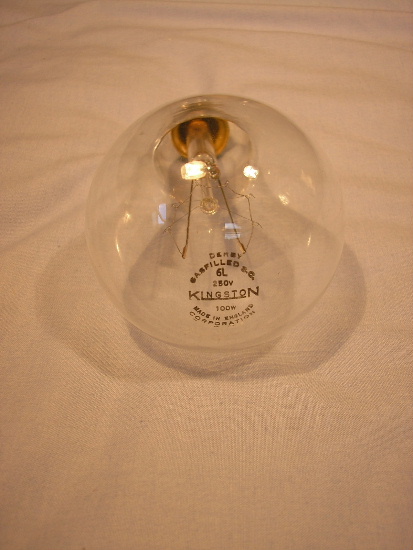
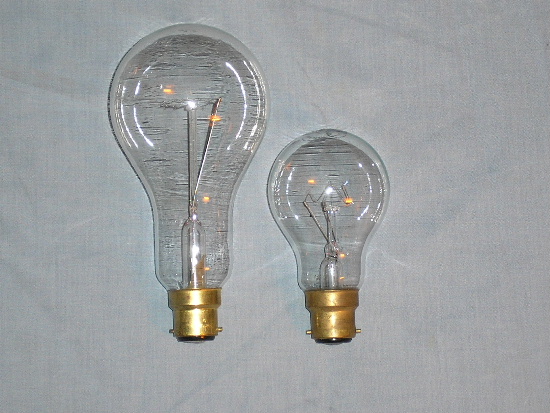
The 'Derby 100' Large Envelope 100 Watt Street-Light Bulb - A History By Jeremy Skertchly For around fifty years, all of Derby's tungsten street lights employed a special 100 Watt GLS bulb which was peculiar and unique to Derby. While many regarded this as only an 'ordinary' light bulb, as opposed to discharge and fluorescent lamps, it was in fact a custom or bespoke lamp, made specially for Derby and, to my knowledge, never used anywhere else. Most authorities used 150 Watt lamps in tungsten street lights and Derby was unusual from the outset in that it always specified 100 Watt lamps. The 'Derby 100', as these bulbs became known, were essentially a normal 100 Watt clear gasfilled single-coil GLS bulb, but they differed from the average 100 Watt bulb in having the large 80 mm diameter by 160 mm long glass envelope, normally employed on single-coil 150 Watt and 200 Watt lamps. 'Normal' 100 Watt lamps had a standard 60 mm diameter envelope. This strange sized lamp came about shortly after the Second World War, around 1952, when bulb manufacturers began to standardise on the familiar 60 mm diameter envelope for all bulb sizes up to 100 Watts. Until this time, every lamp wattage employed a different sized envelope - 40 Watt lamps were the only size using the 60 mm envelope; 60 Watt lamps were around 68 mm and 100 lamps were around 70/75 mm - the sizes varying from manufacturer to manufacturer. As the 'new' 60 mm size 100 Watt lamps began to be used by Derby's street lighting department, several problems became apparent with the new 'small' bulbs - firstly, the new lamps ran considerably hotter than the old, larger type and it was found that, as most of the street light fittings were open-type lanterns, such as ESLAs, the bulbs would burst in the rain. Secondly, it was found that the much shorter neck and light-centre-length (LCL) of the 'new' bulbs caused problems with the focusing and light distribution of many types of lantern, especially multi-ray type lanterns such as ESLAs. This resulted in dark areas often appearing in streets which only had two or three street lights and which had, previously, been adequately lit. The problem was often quite severe; especially at islands and large road junctions.
In order to eliminate this problem, Derby engineers approached Kingston Lamps of Hull, who at the time supplied all of Derby's bulbs, including traffic signal bulbs, rough service bulbs, pygmies, bulbs for schools and public buildings and all the coloured bulbs for the Christmas decorations. They enquired if it would be possible to continue to supply the 100 Watt single coil clear bulbs for street lamps in the 'old', larger size owing to these problems experienced with the 'new', small bulbs. Kingston lamps came back with the reply that they could no longer supply the 'old' large size bulbs as they had standardised on the one size - namely the 60 mm envelope, for all lamp wattages up to 100 Watts. However, they offered a possible solution: to produce 100 Watt bulbs in the 80 mm size envelope, which was the standard size for single coil 150 Watt and 200 Watt lamps. These were slightly larger than the original 'old' size of 100 Watt, of around 70 mm, but this was the only solution available due to the standardising of production lines and machinery etc. One hundred sample lamps were made in January 1952 (of which I have three) and 'tested' in service. The lamps proved a great success - even better than the originals, and thus the 100 Watt large-envelope 'Derby 100' 100 Watt bulb was born. These large 100 Watt bulbs remained the standard 'Bread-and-Butter' bulb of Derby's street lighting department for the next fifty years. Kingston Lamps continued to supply bulbs of all types to Derby until the mid-to-late 1970s - including the Derby 100s. The Kingston brand lamps were actually stamped 'Derby Corporation', 'Derby Borough' and eventually just 'Derby'. Various other manufacturers produced the 'Derby 100' bulbs as well as Kingston Lamps, although only the Kingstons carried the 'custom' stamp. Among other manufacturers producing the lamps were Luxram, Castle, Cryselco, Endura, Maxim, Winfield, Crompton (very rare) and, later, Thorn and Omega. In the early 1980s, Derby started using the excellent quality Omega 'Pluslife' brand of bulbs for various applications requiring GLS lamps - including public buildings, toilets, telephone boxes etc and it was only a matter of time before Omega (part of Thorn) were asked if they could produce the large-envelope 100 Watt 'Derby 100' bulb in the Pluslife brand. As the street lighting department ordered the lamps in large quantities - a thousand or more at a time - this was no problem and from then on, 'Derby 100' bulbs were made exclusively in the Omega 'Pluslife' brand until Omega were absorbed into GE in 1990/1991. A very few lamps (only 100 or so) were made in the 'Thorn' brand, complete with Thorn packaging etc, but these were actually identical in construction to the Omega Pluslifes - the only difference being the 'Thorn' stamp on the bulb. GE continued to produce Pluslife lamps for a short while after 1991, but with their own stamp on the bulb. The quality, however, diminished and, like the last of the Kingston-brand lamps, the GE badged ones were inferior and had aluminium bases instead of brass. Aluminium-based GE brand 'Derby 100' bulbs now are extremely rare as, again, relatively few were made.
After approximately 1992, no more large-envelope 'Derby 100' 100 Watt bulbs were manufactured at all, but they were still in use, and continued to be so for the next eight-ten years as the street lighting department had a vast quantity in stock and relatively few tungsten street lights were left in service to use them up. In 1997, I bought up what stock was left (around 500 or so lamps) of the 'Derby 100' 100 Watt bulbs from the street lighting department as I, and a few other collectors and lantern enthusiasts, still use these in our ESLA lanterns. These bulbs will never be made again and they are a small part of Derby's history. Although they were intended primarily for street lights, the large envelope 'Derby 100' 100 Watt bulbs found their way into numerous other applications including public toilets, substations and switchrooms - the 'Strand' shopping arcade in Derby and Derby's Market Hall and Eagle Centre (in its early days). In ESLA lanterns in particular, I personally feel that the larger bulbs are much more in proportion to the lantern and have a much better appearance - either lit or unlit. To this day, many of these bulbs are still to be found in all sorts of places including council stores, caretakers' and cleaners' rooms and gardeners' store sheds in parks and cemeteries, in cellars and attics in council premises and yards etc, all over Derby. Please note that Omega 'Pluslife' brand bulbs (and various brands of long-life and rough-service 100 Watt bulbs) are available in a 68 mm size bulb. This should not be confused with the much larger (80 mm) 'Derby 100' 100 Watt bulb.
|
||||
|
Following Jeremy's untimely death in 2021, a scanned copy of his original handwritten notes on the subject of the 'Derby 100' can be read by clicking here. For James Hooker's comprehensive write-up of the Rodney Lampworks, which made the Omega Pluslife Derby 100s, please click here. |
CLICK HERE TO MAKE A MONETARY DONATION
© 2002 - English Street Lights Online